Sandstone Heritage Trust – Rail News
<< Back to Locomotive information and galleries
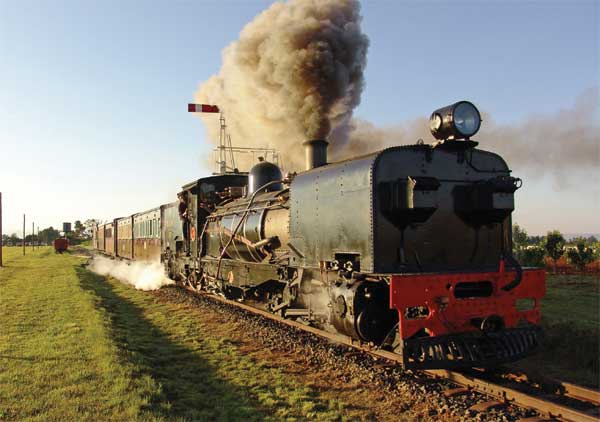
ex SAR NGG13 number 49 Hanomag 10599/1928
Updated – 15th May 2006
Although carrying the lowest number of the NGG13 class, this locomotive is actually the fourth member of the class to be built and was allocated to the Port Shepstone to Harding line. Interestingly number 49 and sister loco number 50 actually spent until 1933 working on the Otavi Railway in South West Africa as part of an experiment to test Garratt locos there. On its return to South Africa it went back to Port Shepstone where it remained for its working life. With the advent of the 91 class diesels on the Avontuur line, the NGG16 locos working there were cascaded to the Natal region and the entire NGG13 class was withdrawn in the mid 70s. Number 49 was moved to Umlaas Road depot for preservation. In later years it was moved to Springs Depot with NG15 number 17 where it also disappeared into the undergrowth over the years.
In May 2002 number 49 was removed from Springs to Bloemfontein. By now it was overgrown by a large tree and with its engine unit pivot points rusted solid its release from the captive bush was no easy matter. Once in Bloemfontein the loco was stripped by Lukas Nel and his team but it was decided to complete the restoration of “Kalahari” number 17 first. Also under restoration at this time was the Class NGG11 Garratt for Paton Country Railway. With a shortage of fittings for two Garratts the NGG11 was completed first. It was not until October 2004 that number 49 steamed for the first time and it was then moved to Hoekfontein and commissioned in November 2004. Painted in SAR black, number 49 has been rebuilt virtually to the last nut and bolt and is a testament to the engineering skills of Lukas Nel and his team.
Number 49 is on lease lend from the Transnet Foundation.