Sandstone Heritage Trust – News
17th March 2005
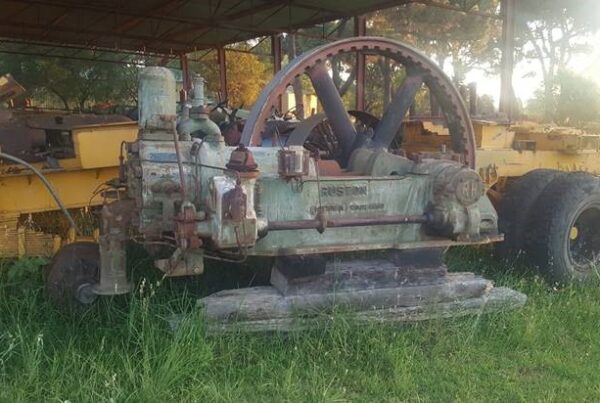
Hoekfontein is the central farm at Sandstone Estates and houses both the headquarters of the commercial farming operations and the heritage centre. A pre-war National engine which was apparently purchased second-hand by the Wille family who owned the farm for 150 years has remained in the same place where is has been for many years and is in immaculate working order. However, we don’t have a clear idea of how old this engine is and if any readers of this article could throw some light on that we would be most grateful.
To provide background information on National engines we have re-produced details from Patrick Knights outstanding A to Z on stationary engines.
 |
||
| The National Gas Engine Company Limited. Wellington Works, Ashton-under-Lyne. | ||
| This is an original article, retyped. The original thumbnails are below. | ||
|
Founded by Henry M. Bickerton, the National Gas Engine Company Limited was established in 1890, with the production of gas engines to an improved Otto design it’s prime objective. Henry Bickerton was no stranger to the world of the i/c engine, having previously been involved with Mirrlees-Bickerton & Day, builders of the Mirrless diesel engine.
Thos early engines were well received, to the extent that within a short period engines were being produced in a wide range of sizes from 2hp to 160hp. It should be noted that power ratings were quoted for operation on good quality coal gas. Under normal circumstances, The National Gas Engine Company would supply engines fitted with twin flywheels and centrifugal governors. There were, however exceptions to this rule. The small F-Type (1hp) and J-Type engines (2hp) were fitted with a single flywheel, while at the other end of the scale, the ZC model (160hp) cam out with a single large flywheel and out-rigger bearing. Where an engine was supplied for generating purposes, single or twin extra-heavy flywheels would be fitted. In such instances the prefix letter “E” would appear after the model letter i.e. LE, ME etc. The model “F” engine differed from the general specification in that it was fitted with an enclosed crankcase, allowing an oil bath lubrication system to be used. By 1905 a range of heavy-duty engines were being produced in single and twin cylinder forms. The twin-cylinder models, built up to 250bhp, were designed with a side-by-side layout, whereby should one of the cylinders become inoperative for any reason, the piston and conrod, etc. could be removed and the engine put back into service while repairs were effected. This was something not possible to twin-cylinder engines built on a vis-à-vis (horizontally, opposed) layout. While The National Gas Engine Company found production moving towards the larger industrial type engines, they did not forget the needs of the small power-user, for in 1906, the “K” Type range of horizontal petrol engines was introduced. A further change occurred around the mid 1920’s when the popular Wico EK type magneto was introduced in place of the Hills magneto. In late 1912, the company were reported as building 270 engines per month in the 1 to 1, 500bhp power range. Of these smaller models had overhung cylinders, while the larger models employed a girder-bed with cylinder support. Engines up to 185bhp could be had in single-cylinder form, while the larger models were offered in multi-cylinder forms, either horizontal or vertical. During the 1912/19 periods, the majority of crankshafts used by The National Gas Engine Company were purchased from Mitchell Shackleton & Co. and the letters “MS & Co.” plus two digits, indicating the year of manufacture were stamped on the side web. Around 1929, a small, horizontal, enclosed-crank petrol/paraffin engine was introduced. Developing 2 1/4 to 2 2/4 bhp at speeds of 800/1000rpm, it was offered with either hopper or tank cooling. The ignition was by Wico EK trip magneto or Wico rotary magneto, which was located, somewhat vulnerably, at the rear of the crankcase. The fuel tank, located over the crank actually formed part of the crankcase. A gas version was also offered in which the fuel tank was replaced by a simple cover plate. An unusual feature of this model was that the interior surfaces were painted an orangey-red colour. In 1932, the company title change to National Gas & Oil Engine Co, and a year later the model LB horizontal heavy oil engine was introduced with the smaller power user in mind. Rated at 10 – 11bhp, the LB featured a fully enclosed crankshaft and was of the cold-starting type. The general-purpose industrial model came with twin-flywheels, while the electrical model (LBE) was fitted with a single heavy flywheel. Around 1935, the small vertical BS, DS & ID range of engines were introduced. One special feature of these engines was their renewable cast iron cylinder liners. In 1949 the Brush Group took part control of The National Gas & Oil Engine Co, a situation that continued till 1961 when they took over completely. From that date, the company started trading as Mirrless National Ltd. |
||
 |
 |
 |