This unit was one of the first diesel locomotives in South Africa and certainly in the sugar cane industry. While the mines were using diesel and petrol machines in the late 20s, the Avonside at Ellingham in 1930 was the first of its kind in its industry. It was not until 1939 that the national rail operator, South African Railways, introduced diesel shunters in Durban goods yard. At the same time Avonside realised the articulated steam locomotive would be attractive to Avonside’s sugar estate customers, as it would give a much more powerful machine that could operate over the lightly laid and badly maintained track of the average estate. This was to be a key element in the eventual unique diesel locomotive that was supplied to Ellingham. At Ellingham Estates in South Africa in 1926, the owner, Fred Crookes, was concerned over the fire risk of operating steam locomotives in the cane fields after a devastating fire at Illovo Sugar had destroyed thousands of acres and killed 22 people. Although no suitable diesel locomotives were immediately available Crookes contacted Avonside and all these ideas came together in 1930 when they produced a design for a double-bogie 0-4-4-0 diesel of two-foot gauge for the estate railway utilising the concept of the articulated steam locomotive frame matched to diesel power. Works number 2046 had a Gardner 6L2 diesel engine mounted on a full-length main frame of rolled steel sections, which also carried the three speed gearbox, water and fuel tanks and central cab.

The Avonside at work at Ellingham Estates in the 1930s
The drive was taken to the two bogies via a reversing gearbox mounted centrally with cardan shaft drive to a worm and wheel on the outer axle of each bogie and the wheels connected by conventional side rods. Although the locomotive remained a one-off it was perfectly successful. More importantly the frame and bogie design was utilised in a later twin-cylinder articulated geared steam locomotive. Sadly, Avonside was unable to survive and was liquidated in 1934. The locomotive was set aside when, as in common with most of the South African sugar estates, Ellingham moved to road transport. The locomotive was purchased by Sandstone in 2023 after spending some time at Sandstone on display.
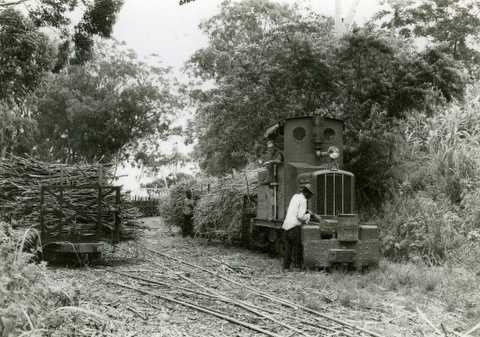
A service stop at Ellingham Estates.

The Ellingham after arrival at Sandstone.
The mechanical side of the Ellingham Diesel Locomotive, engine, radiator etc. has been inspected and the engine looks fine but needs a starter, fuel line, intake airpipes and filter, water hoses to the radiator. The engine condition will only be determined when it is complete and can be started. Gardner diesel engines, however, are well known for their strength and spares are readily available in the UK and Ireland.

The bogie system of the locomotive

The Ellingham resting between duties.
For railway operation the locomotive appears in good condition except for one wheel flange that has a groove in due to brake block misalignment. This can be easily fixed with tyres being recut before putting the locomotive into service. The Locomotive cab and drive shafts are all in place so the locomotive is fairly complete and will not take much work to put back into running order. A starter motor has been obtained from Tangent Engineering in Ireland while the other mechanical items are available in South Africa. Statfold Barn Railway in the UK, who are good friends of Sandstone, hold all the remaining drawings existing for Avonside locomotives and have been extremely helpful in supplying some useful drawings for this diesel which will greatly assist us in its rebuild and return to service. The locomotive is now in Johannesburg for restoration.