During the First World War the German Military set up a series of field railways (feldbahn) to serve various military installations and ultimately front line positions. The rail system was known as the Deutschefeldbahn (DFB). A 0-8-0TT locomotive which became known as the “Feldbahn” type or “Brigadelok” was built by numerous manufacturers to serve this system. A prototype was built in 1903 and in 1905 production began, continuing until 1919. The majority being built after the outbreak of WW1. In total 2473 were built including this 1915 example from 789 built by Henschel. Other manufacturers were O&K and Borsig plus several others. They were the largest type of locomotive used on the DFB and number 498 saw most of its service in the Berlin area. The locomotive has a relatively high boiler pressure of 215lbs/sq. in, and they are designed to haul 70 tons at 15kmh. Spark arrestor chimneys were fitted to enable night time use without detection.

The Feldbahn at work at Sandstone
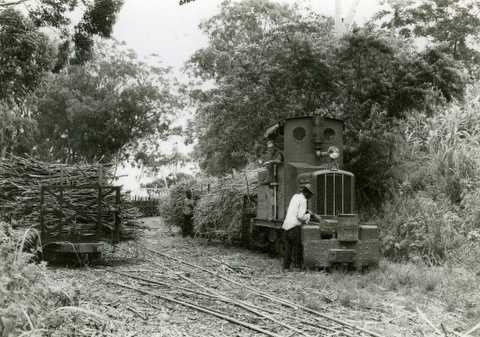
After the armistice numerous examples of these locomotives were sold around the world including at least 13 to Sena Sugar Estates in Mozambique for use on the Marromeu and Luabo systems of the estate. DFB 498 became Sena number 2. Sena number 3, DFB 526, another Henschel example, survives on the Amerton railway in the UK. It is believed that at least 100 examples survive around the world.
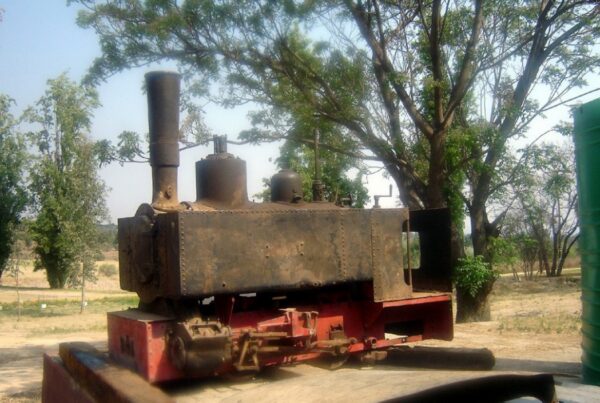
A large number of locomotives from the two Sena systems were sold overseas in 1999/2000 and ended up parked in a quarry in Warwickshire in the UK. Number 2 was acquired for Sandstone and returned to South Africa in 2004, basically complete, but a number of critical parts were missing. However, with the considerable number of these types of locos worldwide, contact was made with other owners to either source or remanufacture such parts. Restoration took place at the Bloemfontein workshops under the watchful eye of Lukas Nel.

The Feldbahn at Sena Sugar in 1975 (Photo courtesy of Geoff Cooke)
The nomenclature “TT” indicates tender tank. Although fitted with side tanks many Feldbahn pulled an auxiliary tender. At Sena, number 2 had a makeshift tender and an open rear to the cab, but this was closed up during the rebuild.
During 2017, however, severe cracks were found in the firebox, and after the boiler was removed for further examination locomotive was taken out of service. In a first for Sandstone, and in railway preservation in South Africa, the locomotive is to be fitted with a new boiler.

Sena number 2 as discovered in the UK.

The old boiler of the Feldbahn removed from the frames for inspection.
The locomotive has been moved to the workshops of the Winelands Light Railway near Stellenbosch in the Western Cape Province of South Africa. Under the management of Andries Keyser, it is set to receive a new all-welded boiler, marking another important milestone for railway preservation in South Africa. The construction of this boiler represents a significant first within the country’s heritage railway sector.
The original boiler was meticulously measured and documented, with a complete set of drawings prepared and submitted to Steam House, a Cape Town-based pressure vessel manufacturer. Their engineering team subsequently reviewed and refined the design, carrying out the necessary calculations to ensure full compliance with modern engineering practices and safety standards.
Over the years, the locomotive’s working pressure was reduced to 180 psi due to the deteriorating condition of the original boiler shell. The new boiler will allow the locomotive to be restored to its original operating pressure of 215 psi, significantly enhancing its steaming capabilities, efficiency, and overall performance.

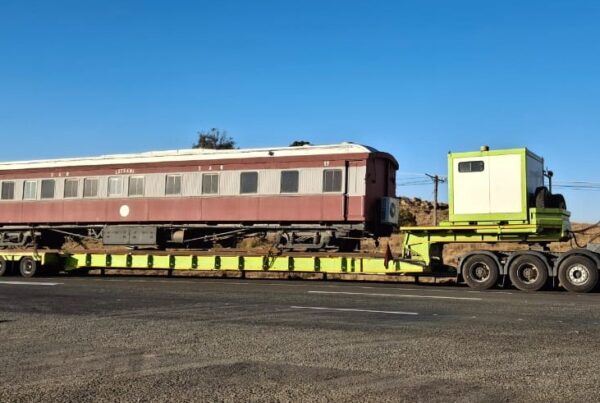
The Feldbahn, loaded for its trip to Cape Town, says goodbye to its old boiler!
The boiler barrel has been rolled to shape and welded, while all remaining platework has been either water-jet cut or CNC machined. The new backhead design incorporates a slightly larger firehole, providing improved access to the fusible plug for inspection and maintenance. It has also been fitted with flanged mountings to accommodate ex-SAR boiler fittings, ensuring compatibility with readily available components and avoiding the difficulties associated with sourcing specialised fittings in the future.
All of the boiler components have taken three months to fabricate and machined and is currently being put together in the Cape Town workshop. Andries Keyser has been in communication with other Feldbahn owners and operators around the world so that best practice can be used on the Sandstone example.


With the Feldbahn safely in Cape Town the new boiler outer shell has been test fitted to the frame in the WLR workshop.
Our thanks go to all these operators for their overwhelmingly helpful responses. A final steam test is expected by the end of 2026.The boiler will receive new cladding, several new fittings and a complete new set of plumbing to complement the new boiler before the locomotive is signed off and returned to Sandstone.